
Rethinking Mental Health After the Elijah Hollands Incident
Elijah Hollands incident is a reminder that we need to learn to be better at recognising risk and how we talk about mental health
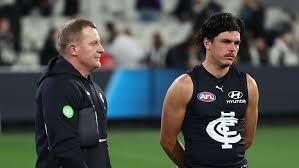
The on-field incident involving Elijah Hollands during the Carlton vs Collingwood match on 16 April 2026 has sparked an important conversation—not just about what happened, but about how we understand, talk about, and respond to mental health in high-pressure environments like elite sport.
The Problem with “Mental Health” as a Catch-All
We use the term “mental health” often—but not always clearly.
Sometimes it refers to everyday experiences like stress or nerves. Other times it refers to more serious conditions that affect how someone thinks, feels, or behaves.
When everything is grouped under one label, it can blur important differences. Not all distress is the same, and not every difficult moment is a clinical issue.
Using clearer, more grounded language helps people better understand what’s actually happening—and respond appropriately.
What We Typically See in Sport
Most mental health challenges in sport are managed quietly and effectively:
- Players deal with anxiety, pressure, or emotional strain
- They use coping strategies and professional support
- These experiences are often not visible during games
That’s why situations that become visible during play stand out—they’re not the norm.
When Something Looks Different
In this case, what drew attention was what appeared to be a noticeable change in behaviour during the game.
Reports and commentary described:
- Signs of disorientation
- Unusual or unsettled behaviour
- Reduced ability to engage in play over a period of time
When something like this occurs, the most important question is not what label to apply, but:
Is the person able to function safely in that moment?
Speculation vs Responsibility
Following incidents like this, two things tend to happen at the same time:
- Public speculation increases
- Questions about decision-making emerge
There has been a significant amount of discussion about what may have caused the incident. That’s understandable—but it can also be unhelpful.
Without direct knowledge or assessment, it’s not possible to determine what someone was experiencing. Speculating about causes—especially in public—can lead to misunderstanding and may unfairly impact the individual involved.
At the same time, focusing only on why something happened can distract from a more immediate issue:
What was the responsibility in that moment?
Because regardless of cause, when a player appears visibly unable to function as expected, the responsibility shifts to those managing the environment.
Organisations don’t need certainty about the cause to respond—they need to respond to what is in front of them.
A Practical Way to Think About It
Rather than focusing on labels, it can be more useful to think in terms of functioning:
Everyday distress
- Stress, anxiety, emotional reactions
- People can usually continue performing, even if it’s difficult
Increased difficulty
- Noticeable changes in behaviour or concentration
- Performance may be affected
Situations requiring immediate attention
- Clear signs of confusion, disorientation, or inability to engage
- Reduced capacity to perform safely or effectively
The key difference is not what we call it—it’s what the person is able to do in that moment.
Why This Matters in a Game Setting
In elite sport, decisions often come down to a simple question:
Can the player safely continue?We already apply this standard to physical injuries.
If a player is concussed or physically compromised, they are removed from play.
The same principle applies more broadly:
If a player shows signs of being unable to function normally—whatever the reason—this should prompt immediate assessment and consideration of removal from play.
Staying Within What We Know
It’s important to be clear about the limits of public commentary.
Describing what was observable is appropriate.
Explaining why it happened requires information that isn’t publicly available. It is important to make the point here that the Carlton Football Club is best placed to know and act according to the player's wellbeing. There is no assertion here that this was not the case.
Keeping that distinction matters—not just for accuracy, but for fairness.
Professional standards for all health professional including psychologists emphasise assessing the evidence presented, acting in situations at hand to respond to what is happening to their clients in real time.
As well as maintaining clear boundaries, communicating carefully, and avoiding statements that could mislead or go beyond available evidence.
Key Takeaways
1. Avoid speculation about causes
It’s natural, but it can be misleading and unhelpful without full information.
2. Focus on observable behaviour
What can be seen—such as disorientation or inability to engage—is what matters in real time.
3. Responsibility sits with the system
Clubs and organisations are responsible for responding to risk, regardless of cause.
4. Safety should override uncertainty
You don’t need a diagnosis to act—you need enough evidence that something isn’t right.
5. Use clear, grounded language
Describing what happened is more helpful than labelling or guessing.
Final Thought
The Elijah Hollands incident is a reminder that we need to get better at two things:
- How we talk about mental health, and
- How we respond when something clearly isn’t right
Speculation will always follow moments like this. But the more important question is simpler:
Can we recognise when someone may not be okay—and act quickly to support them?
Getting that right is what ultimately protects players—not just in theory, but in real time.