
Six Skills You Need to Get Unstuck
Feeling stuck? The six ACT skills, from defusion to committed action, build psychological flexibility. Franco Greco explains each pivot simply.
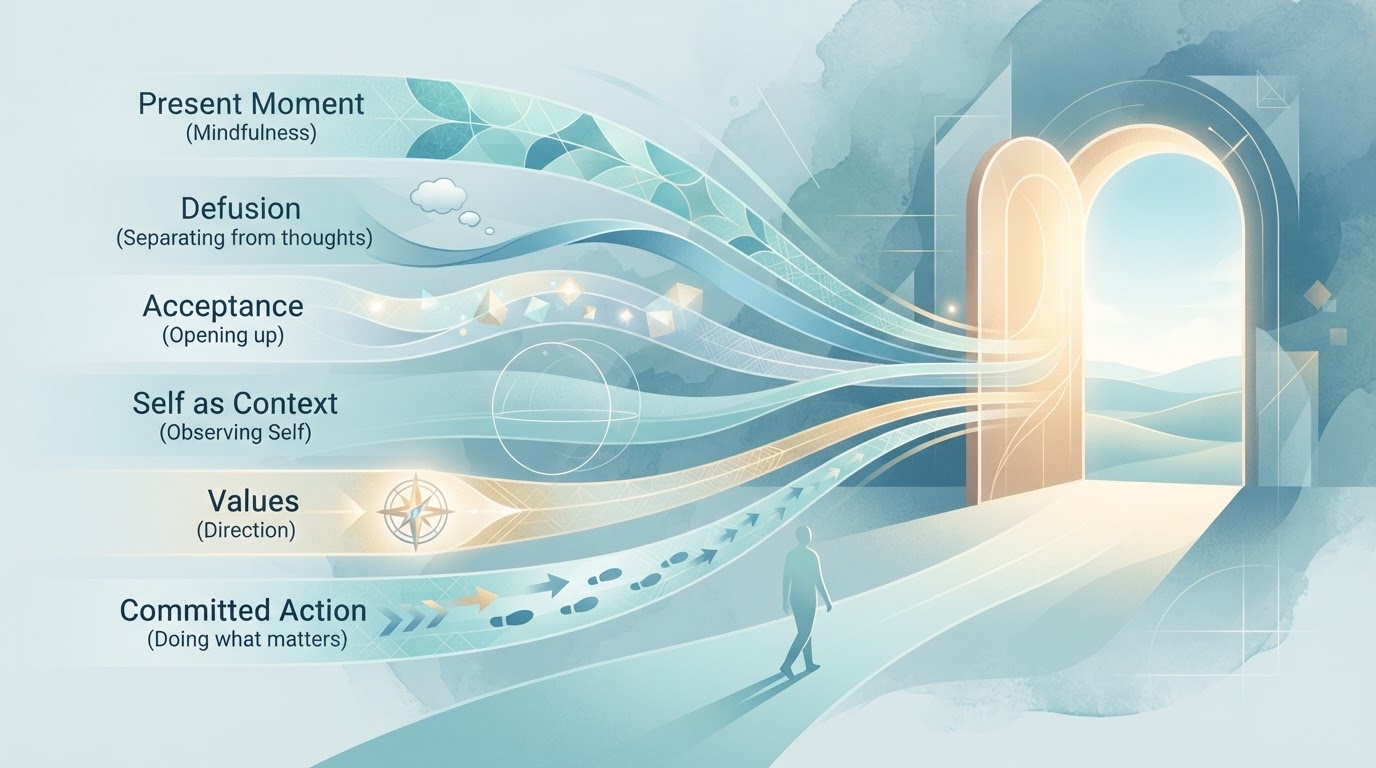
Achieve psychological flexibility and positive change in your life.
I often see clients in my therapy practice who feel stuck.
Recently, a client I see in my consulting room said, "Franco, I don't know why I get stuck ... it's like I can't shift the way I am thinking about my life!"
Sadly, I hear this quite a lot from my clients!
They are at times strongly attached to a story about themselves that they can't shake free from.
They have an inflexibility or rigidity in the way they see their life, and time and time again try the same ways of solving their problems: changing relationships ... changing jobs ... drinking alcohol or taking drugs.
They attempt to avoid, suppress or fight against their uncomfortable feelings of pain ... anger ... frustration ... shame ... sadness ... guilt.
Being absorbed in their everyday hassles ... like they are on autopilot ... they lose sight of their values ... what is important ... and as a consequence can't commit to change or live life as they would like.
Do you recognise yourself ... or someone you know?
Acceptance and Commitment Therapy
I regularly listen to The Psychology Podcast, hosted by Dr Scott Barry Kaufman. He recently interviewed Dr Steven Hayes, the originator of Acceptance and Commitment Therapy (ACT). Dr Hayes talked about his life, the development of ACT, and his new book, A Liberated Mind: The Essential Guide to ACT.
The book outlines six steps, or pivots, to develop what Dr Hayes coined 'psychological flexibility'.
Psychological flexibility refers to one's ability to focus on the present moment fully and, according to what the situation affords, change or persist with behaviour in the pursuit of goals and values.
We become psychologically inflexible when we choose rigid and inflexible reactions over chosen values in guiding behaviour. As I discussed earlier, this often occurs when individuals attempt to avoid experiencing emotional pain ... sadness ... guilt and shame. This can lead to people feeling depressed and anxious and engaging in unhelpful behaviours.
The Six Pivots
Psychological flexibility involves six skills, and building each of these involves its own pivot away from rigid mental processes.
Central to understanding why the pivots are so powerful is that each of the rigid ways in which our minds trap us in unhealthy patterns of thinking and behaving contains a healthy yearning hidden deep within it.
We are doing the wrong things, but for the right reasons – because we want our lives to have important qualities.
The flexibility pivots allow us to redirect that hidden yearning towards a more open and flexible way of being that can actually satisfy it.
Here is a brief introduction to each of the skills and the yearning each pivot redirects:
- Defusion – requires pivoting from fusion (buying into what your thoughts tell you and letting what they say over-determine what you do) to defusion (not connecting with them). We connect to thoughts as a way of finding coherence and understanding. The pivot of just noticing the act of thinking without diving into it ... distancing yourself from your thoughts ... redirects our need for coherence and understanding.
- Self – requires pivoting from remaining loyal to unhelpful stories about ourselves to a perspective-taking self. Sometimes we have a story about who we are and what others are in relation to us. Sometimes these stories are helpful. Sometimes they are not helpful ... we hold on to them too tightly ... like "I always fail" ... or "people don't like me". We do this to satisfy a need to connect and belong. The alternative to connecting to these stories is perspective-taking – a sense of observing, witnessing or being aware that we are more than the stories we tell ourselves.
- Acceptance – requires pivoting from experiential avoidance (running away from or attempting to control our inner experiences, like thoughts, feelings and sensations) to accepting that we actually think, feel and sense. This redirects our need to feel rather than avoid.
- Presence – requires pivoting from rigid attention driven by the past (ruminating about things that have happened) and the future (worrying about what might happen) to being attentive to what is happening now. This pivot redirects our need for orientation. We often fear becoming lost, and we tend to look to the past and the future to be oriented. But instead, we find ourselves in a mental fog of what was or what will be, when there is really only what is. We have a choice to experience the right now at every moment.
- Values – requires pivoting from socially compliant goals (things we think we should do or have to do) to chosen values (things we meaningfully connect to or want to do in order to live our lives). Values are a more effective and sustainable source of motivation, and this pivot redirects the need for self-direction and purpose.
- Action – requires pivoting from not doing, or putting off, to committed action. It's about recognising that change requires some action ... some small steps of behaviour change. I see this as the hardest one for clients to enact. Why? When clients seek to change, don't succeed and reflect on why, they have often set high expectations or sought perfect outcomes. Building good habits is a moment-to-moment process. The Action pivot focuses us on competently and continuously building habits in small steps, linked to our values.
In Summary
Together, the six pivots help us to:
- see our thoughts with enough distance that we can choose what we do next, regardless of our mind's chatter;
- notice the story we've constructed of ourselves and gain perspective about who we are;
- allow ourselves to feel, even when the feelings are painful or create a sense of vulnerability;
- direct attention in an intentional way rather than by mere habit, noticing what is present here and now, inside us and out;
- choose the qualities of being that we want to evolve toward; and
- create habits that support these choices.
I hope this article has been useful. Please get in touch if you want to explore how these pivots might help you.
Written by Franco Greco
Clinical & Counselling Psychologist • Internationally Accredited Schema Therapist • Gottman-trained. Melbourne-based, with in-person and Telehealth sessions.
If this resonates, take the next step
Articles inform — therapy transforms. A free 15-minute call is the simplest way to explore whether Franco's approach fits your needs.